Thursday, January 15, 2026

Saturday, February 3, 2024

Saturday, June 18, 2022

Poem Stanza
The sewing machine
and the stereo
eventually went to the Goodwill
it goes on the floor by the seat
in a car back.
Thursday, March 24, 2022
Monday, August 17, 2020
Saturday, August 1, 2020
A Short Entry
For about four months I have not been able to sign in to my blog Spice Drawer Mouse because the computer room at the building has been closed and blogger did not recognize the laptop. Now it is August.
Tuesday, March 17, 2020
Janet Forza Northern State Hospital Newsletter Article, May 10, 1940

“Where
Cross the Crowded Ways of Life” In two
past blog entries I explain how I knew my father was in the army and that he
had been the pharmacist at Northern State Hospital. In Northern State Hospital’s newsletter,
columnist Janet Forza includes a shared moment with the “postal representative”
in a piece published May 1940. A swarm of bees has arrived at the front lawn.
It was psychiatric
hospital. Some of the patients were drug
addicts. The United State Post Office
truck unloaded where the pharmacist sorted the mail. The
hospital relied on the pharmacist to watch for possible contraband and to analyze any unknown
substance at the pharmacy laboratory. The
pharmacist received packages that supplied orders for drugs and necessities. The
pharmacist photographed patients when they entered. He developed some photographs.
The
postal representative rushed out with camera in hand and by sheer brute force
wedged his way into the midst of the melee and snapped one-two pictures – then
– was seen no more. The column by Janet Forza is titled,
“Behold, the Conquering Hero Comes” and is about nature and man. The column is an extended metaphor which
references ideas in people’s thoughts and conversations in May, 1940, the ideas
included war and even concentration camps.
Below the whole column appears a comment of praise: “The Men’s O.T. has done a classy job of
binding Goethe’s Works for Library.” – the comment of praise for Occupational
Therapy is filler, yet newsworthy. From time to time in the newsletter occurs a comment appears about columns by Janet Forza. People liked her columns. I can include the 1940 article in full.

It was
at Tacoma Public Library that I awaited, with others, the 1940 United States
Census in 2012. I found Theodore Jensen listed
as pharmacist. I had glimpsed the 1930
census of Northern State Hospital to determine that among employees at the
hospital were names of English Descent, among patients were a larger
representation of names that were non-English.
Recently,
when Tacoma Public Library had logged me in to Ancestry, I found a physician
listed at Northern State Hospital listed as private or unknown at a family
tree. The assignment of privacy or unknown
requires a respectful distance, although I have no way of knowing about the
physician’s distant family member who created their tree. The tree includes a beautiful professional
photo, others with the wife of the physician as a young girl. The private or unknown designation can be about
stigma, about the wide category of difficulty associated with the institutions.
Janet
Forza’s first home address exists along a maze of old two-story row houses,
where at places there are churches or public buildings, on Google Earth Street
views. She was born Janet Allsopp, and
is 2 years old, in Derby, in a United Kingdom 1920 Census. Derby, it seems, is close to the middle of England. Her mother, a widow in the United States,
married Joseph Forza, who was born in Austria.
Janet Forza is in the 1940 United States Census as 22 years old and
working at Northern State Hospital as a stenographer. At Ancestry at Tacoma Public Library, I find
Janet Forza is included in family trees.
Janet Forza is buried in a Sedro-Wooley Cemetery, on Find a Grave, not
the hospital cemetery.
Regarding
the appearance of Theodore Jensen, there to photograph this event so
momentarily: I can also include one
photograph of hospital days saved among his other photographs. it is a
photograph of a work crew I think putting down tar on the road at the hospital,
this is work therapy, another occurrence during a hospital day. It is unusual for there to be among my father’s
photographs a Northern State Hospital Photograph. Where Cross the Crowded Ways of Life.
Friday, February 21, 2020
Janet Forza, Hospital Stenographer, at Northern State

Public Discussion of the Holocaust
Over many years public discussion of the Holocaust referenced medicine. My father, who worked as a pharmacist, put on his tie mornings at a mirror in our living room, wore a suit and his raincoat to catch a bus to the drugstore.
The references compared medical institutions to concentratioin camps. This is a quote from Life Magazine in 1946: “Through public neglect and legislative penny-pinching, state after state has allowed its institutions for the care and cure of the mentally sick to degenerate into little more than concentration camps on the Belsen pattern”. – Bedlam: 1946 by Albert Q. Maisel
Albert Deutsch referred to World War Two when he published an expose of mental hospitals called The Shame of the States in 1948: “… these (hospitals) were for the most part too understaffed to be very effective even before the military recruitment of medical personnel during World War II crippled clinic staff. "
Albert Deutsch quotes a novelist, Ellen Philtine, in The Shame of the States: “Rank in a state hospital is more rigid and counts for more, perhaps, even than in the Army. The hierarchy starts with the superintendent or director and ranges all the way down to attendants, with only patients lower.”
In about 1961, my mother and father watched our tv set in the living room from the chairs at the dining room table. I was not an only child. They supervised as we saw a documentary about Nazi Germany and the Holocaust. A moderator interviewed people, maybe there was a coffee table, they were in chairs. During the discussion they told about horrors and perversities. Nazis made lampshades out of human skin. (This strange fact is supported and documented.)
From the dining room chair my father can have remembered that he worked at Northern State Hospital in 1939 when Hitler invaded Poland. He worked for Northern State Hospital for eight years or so. He stopped in the spring of 1941. He must have remembered the wards for patients and the farm buildings, farmlands, the occupational therapy. He must have remembered the people who worked there.
News
In the 1930s and 40s, to inform about the nearby
Insane Asylum, reporters at The Courier-Times, the Newspaper for Sedro-Wooley,
Skagit County, at times surveyed acres of wards, administrative buildings,
barns and farm areas to publish a Hospital Edition. Some Northern State Hospital staff members
contributed short pieces, Theodore Jensen, the Northern State Pharmacist, wrote
the short description about the pharmacy, a central feature at the hospital
where he filled prescriptions for all the doctors.
In the December weather of 2019, last year, I
took the bus to the Washington State Archives in Olympia, where copies of
Northern State Hospital newsletters revealed a voice to me that was new. Staff or patients could submit articles to a
newsletter published on a printing press at the hospital as therapy. For one an
administrative office stenographer named Janet Forza, an article meant a gossip
column.
Janet Forza interrupts, probes, and scrutinizes,
to create a satiric impression of the gossip columns of Hedda Hopper and others
from the daily papers. The supt. Of
nurses: “She didn’t point a finger at me and ask my name, but saluted me by
name the third day she was here…they say that you have to be very good or very
bad to be talked about…” (From the Janet Forza Column, I Know My People).
A stenographer writing in the Northern State
Hospital News: Published by the Male Occupational Therapy Department, Janet
Forza shows a true aspect of an institution that recognizes superiority: the upper hierarchy of the remote institution, residence and
farm, assumes the gloss of stardom.
I reflect that Janet Forza may have had the
privileged information that her “blue-eyed Viking”, Theodore Jensen, would
enter the U.S. Army Corps of Engineers.
In following issues, he has left for Alaska. And Janet Forza has left a deft impression that
social innuendo has caused this. In 1942
his name appears in lists of Northern State Hospital People in the United
States Army, many physicians are officers, Theodore Jensen has an address at
Fort Lewis.
Interview
February 28, 1941, Janet Forza demands an interview
from the unwilling pharmacist. She
declares his cynicism is a surface matter, he does many unselfish and
gentlemanly things that she perceives though they are to go unnoticed. Her Column, I Know My People, shares the page
with lists of physicians newly part of the Army Reserves.
She writes, “I know you’re a busy man, but I’ve
been waiting four years to psychoanalyze you, so here goes. Be careful there. Someday you’ll have high blood pressure,
turning that bright pink…”
Another Interview
In a story my father tells, “About 1940…I thought I’d better get some kind of proof that I was a native-born American citizen.” Danish Settlers sold his family a log cabin, they wanted to retire and move into town. When my father was born in the log cabin in 1902, there was never a birth certificate. His family built another house near the cabin.
His friends from school told him “…maybe Mrs. Carpenter could tell him something.” Her daughter was married and lived in Sedro-Wooley. Back in Sedro-Wooley once again, at the house she said, “Yes, I remember you…I was the first person to see you. I helped your mother when you were born.”
Theodore Jensen brought back a notary public with affidavit certificates. And Mrs. Carpenter signed the birth affidavit.
Questions
Why did Theodore Jensen join the U.S. Army Corps of Engineers? Did a recruiter suggest he enter the service before he was drafted so that his identity papers could be screened? Did his status as a pharmacist exclude him from the Reserve Officers Medical group? Did he actually step away from his comfort zone at a secluded Sedro-Wooley State Hospital because of emotional complications involving a Gossip Columnist? When the Japanese attacked Pearl Harbor, he had a job at a pharmacy near South Seattle, in Renton, his most recent job experience the Army Corps of Engineers.
(I have visited Washington State Archives in Olympia, Washington for quotes from Northern State Hospital News.)
Friday, February 14, 2020
Privileged Information - To Read at Poetry Reading This evening
 Privileged Information (photo - from family first aid kit) - Happy Valentine's Day
I always knew my father was in the army. I knew because my father would tell stories
about his life.
The story of the MP was just one example, this was the story about the M.P.:
The story of the MP was just one example, this was the story about the M.P.:
I was so worried about my stomach the rest of the way
over that all I ate was some canned milk and a few of those little oyster
crackers. I didn't eat anything of any
substance so when we got over to Liverpool I was pretty weak. I did manage to carry my seventy-pound pack
and my duffle bag which probably weighed another sixty-five pounds up out of
the ship from C-Deck to B-Deck to A-Deck and over the gang plank down to the
dock.
And there I thought I'd take a bit of a rest. So I sat down and leaned up against a little
building there for a few minutes and one of the MP's on the dock came over and
said, “What's the idea? What are you
goofing off for, why are you falling out?”
Why I told him what had happened.
So he sez, “Well, wait a minute.”
When I got my breath he took ahold of one end of my
duffle bag and I got the other and we
hauled it over to what they call a goods wagon, that's sort of a freight
box or freight car on the English railway.
That's where all the rest of them were putting theirs. That's the last I saw of that till we got to
Everley Manor. But if anybody complains
about MP's to me, I always tell em, how, one of em was a friend of mine.
The story about the M.P. was that kind of
story: there are kinds of stories, one
kind was a testimony faithfully remembered, “…if anybody complains about MPs to
me, I always tell em, how, one of em was a friend of mine.”
There is the story, a kind of story, about when a person was
born. It was a nine-day stay at Tacoma General
Hospital. The doctor told her not to try
to have more children. It would probably
kill her, the doctor said. When the Runeberg met at the Valhalla Hall he went
over to announce that I was there, that I was a girl. He must have been at the hospital a lot of
the time.
They would tell me, the nurse when I was born was a
black woman. A Negro woman.
From next door above the house, as soon as we were
at home, my mother’s family probably walked next door to visit from having
Thanksgiving dinner. We took a taxi to
the hospital, my father probably said.
He would tell a story about Lake Whatcom, where he was born in a log
cabin, or a story about working his way through pharmacy school, or about the
army.
My mother would say she did not tell a lot of
stories the way my father did. She could
chime in, like a tapped tone on a xylophone, that my father told the taxi
driver all the way to look out for chuck holes on the road.
He would not talk about patients or about the
medical procedures. Those were
restricted information. He told only one or two stories about working at Northern
State Hospital. Again, he would not talk
about the psychiatric patients or about the medical procedures. These were restricted information. But he would tell one or two stories about
Northern State Hospital. This was how I
always knew my father was in the army.
And how I always knew my father had worked at Northern State Hospital.
Thursday, January 30, 2020
At the United States Archives 1998
 |
| Andrea Baago |
Both scenes I easily recall.
Later in the diary I have taped in the ticket, 27th row, for
the Bob Dylan concert at the Western Washington Fair.
The microfilm was referenced through the set of research
books, German Passenger Ships Arrivals Lists which were at the Tacoma Public
Library. My grandparents came from
Prussian Occupied Denmark, on my father’s side. I had gotten the slicker when I was going to go to
Scandinavia, in 1990. My grandmother’s
name was Andrea Baago. I will include
her name from the Steerage Passengers Listings.
The U.S. Archives are a part of the Northwest. I hope they remain there, although the government may move them, I find this difficult.
Wednesday, January 1, 2020
Thursday, December 26, 2019
The Copy of Little Women That Belonged to My Mother


That Louisa May Alcott as Jo March was married to the professor as a believable ending to her story is presented in the movie with emotional intelligence. I photographed the copy of the book to show and the poem in the prelude encourages me to go ahead and share these photos at the holiday time.
Preface
“Go
then, my little Book, and show to all
That entertain, and bid thee welcome
shall,
What thou dost keep close shut up in
thy breast;
And wish what thou dost show them may
be blest
To them for good, may make them choose
to be
Pilgrims better, by far, than thee or
me.
Tell them of Mercy; she is one
Who early hath her pilgrimage begun.
Yea, let young damsels learn of her to
prize
The world which is to come, and so be
wise;
For little tripping maids may follow
God
Along the ways which saintly feet have
trod.”
Adapted from JOHN BUNYAN.
Wednesday, December 18, 2019
Christmas Greetings From Gord Barbershop 1936
 At Facebook at Historic Tacoma December 17. 2019:
Across 21st Street from the Three Bridges Building (posted about recently) is another bit of Tacoma's architectural legacy and an architectural cousin to The Spar Tavern building in Old Town, the RealArt Theater in South Tacoma and the much-discussed Holy Rosary Church. Built in 1914, it too was designed by the architects Charles Lundberg & C. Frank Mahon. Originally a drug store and barbershop, it now houses Coates Chiropractic and other businesses. It still has a barbershop!

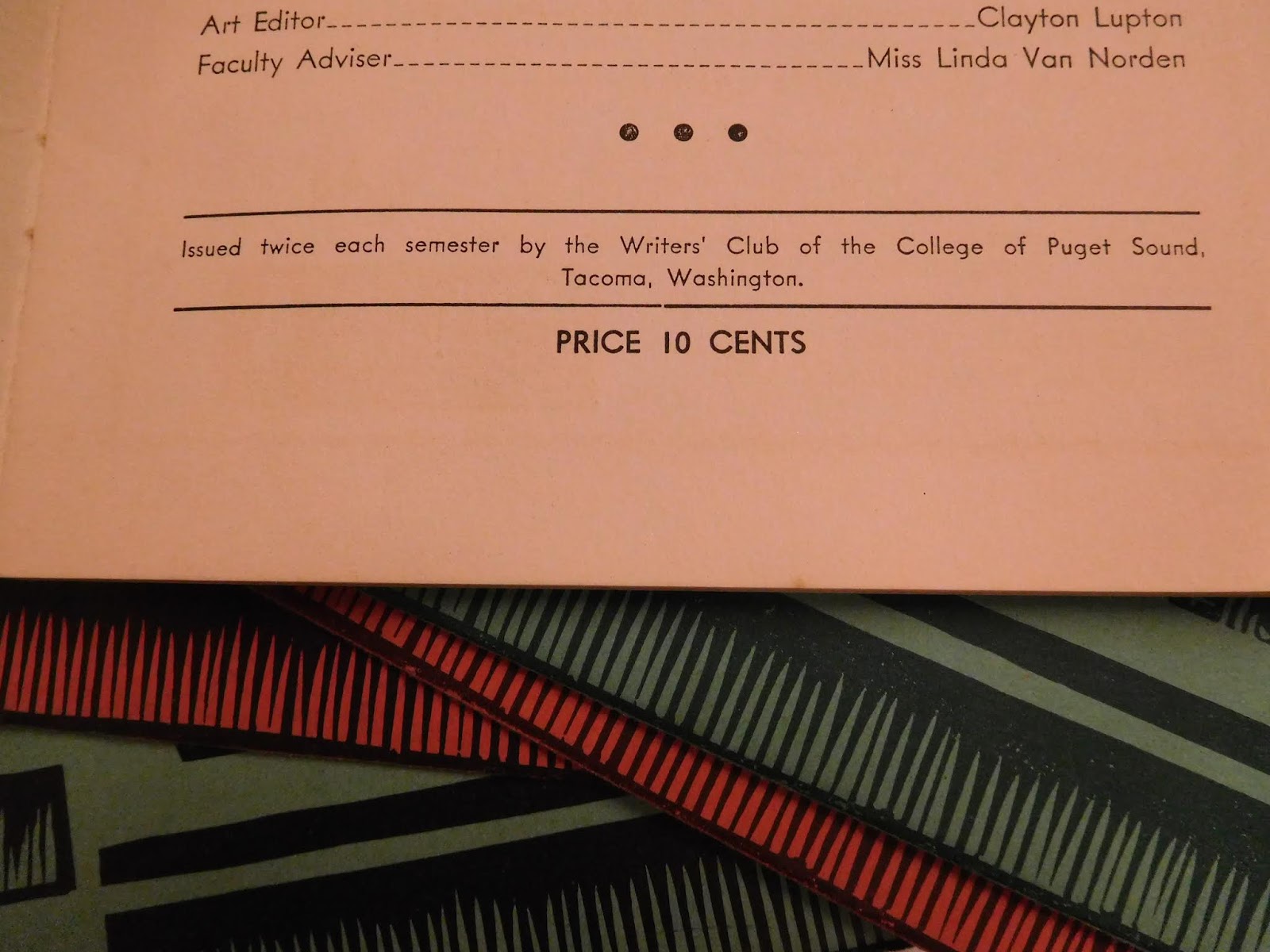
My comment in Historic Tacoma's Comments section included a photo of Tide Literary Magazine from the College of Puget Sound, an advertising section that included Gord Barbershop. My uncle was a barber at Gord Barbershop.
Another commenter could see The Spar in Old Town in this building. Another of the issues with the Gord Barbershop advertisement featured a manger scene on the cover, at the holiday season now, it is to share.

 |
| barbershop building |
Saturday, November 30, 2019
Twenty Years Ago Today
On Facebook a Facebook Friend wants to
know what people were doing twenty years ago today. Since 1987, twelve years, I had been on the third floor of a brick apartment building. I wrote a first diary
entry in a new blank book that begins November 30, 1999. The entry was
a very first entry in a new blank book diary.
Tuesday November 30, 1999
Oh,
I am weary of skipping my mind through the arbitrary days events to guess how
to start off some entry again – all of it feels like I can begin anywhere.
An
old 5-year diary with almost no entries is about watching television programs
at Grandma’s. The whole just did not go
too far.
In
Seattle are marches against the World Trade Organization.
I
am steaming sweet potato (diced) in my nice revereware steamer. (Now this reminds me of some of the letters
from Scandinavia. How the news
information is distracted – in the letter – with up to the minute household descriptions.) I am making Sweet Potato Vinaigrette. Somehow all the historical domestic recollections
are so –
(I also noted down the day elsewhere, and that day I
delivered newspapers for an hour and a quarter.
I spent just a quarter of an hour writing the diary entry. And I worked from two to four at the hourly
library worker job I had found at the University of Washington Tacoma Branch. Both jobs started about six months before, I delived newspapers for five and nearly one-half years.)
Monday, November 18, 2019
The Record Album: Entertainment Drought 1964 and "State Fair" (from July 2019 Spice Drawer Mouse)
The Record Album: Entertainment Drought 1964 And
“State Fair”:
A
1995 Review, Love is in the air (mail)
by Michael J. Vaughn, from the
Internet
The
Anxiety of Influence by Harold Bloom
A Review
A review of two musicals “she loves me”
And “Most Happy Fella”
Refers to “The entertainment drought
That followed the Kennedy Assassination”.
Influence
In the United States that mourned
It is the swerve of Influence described by
Harold Bloom. Along a neural pathway
A specific work of art.
Thought turns instead
To a continuum and immediacy
For that national emergency and shock.
Physically I turn off art
I would have experienced.
In State Fair 1962 the family
Reaches Dallas in the convertible. And thought
Turns instead to the tragedy.
The Record Album
The entertainment drought
Rose from the audience. State Fair 1962
Was set in Dallas. On my album cover
From Andrews and Burnett,
Julie and Carol at Carnegie Hall
Enormous sheepskin chaps
From Neiman Marcus – Big D,
Little A, double-L, A, Ess…
After, I almost never listened anymore.
The concert
While the tv stayed on with serious music
News and No commercials in 1963
She came back in the evening from
The Runeberg Lodge Choir fiftieth anniversary.
They presented their concert but cancelled
The Sunday Banquet and the people
From Canada started back.
From the backyard garage and steps
Through the back porch, into the kitchen.
She would have figured out On Friday
if we had wanted to go with her
that Saturday Evening.
The Record Album, Again
I almost never listened anymore.
Orange cover - They have on their
Enormous Sheepskin chaps from Neiman Marcus.
On the internet: a you tube video of What’s My Line
With Carol Burnett, February 1964.
As she shakes hands with the panel
And she hugs Buddy Hackett,
She continues to look so solemn.
I was confirmed in 1964
In school and In the front pew directly beneath
The national prayer for the bereaved
we continued into spring. Confirmed, young
And influenced, we were bereaved.
Sunday, October 27, 2019


Monday, September 30, 2019
Joy Harjo Read September 1994 for the Distinguished Poet Series

Dorothy McCuistion and I co-edited and co-designed the compilation and each broadside distributed at the Distinguished Poet Series readings. Dorothy, our Tacoma Arts Commission representative for the reading series project, arranged for the compilation to be included at the United States Library of Congress.
 |
| McCuistion |
One day I visited the Tacoma Arts Commission to
assemble the Distinguished Poet Series broadside compilation. Dorothy McCuistion
and I approached stacks of broadsides around a large table. The broadsides
remained from those distributed free at the readings, we printed broadsides
ahead for remaining readings so these too could be included in the limited
edition compilation.
The city scheduled us in a room just off the city
council chamber at the Municipal Building, where the table was large enough for
our broadsides. We placed the broadsides in an order we felt might best set off
the art or meaning of the poem. As we planned, we decided to use my idea that
the broadsides should be placed on facing pages. The first poem in the
compilation is Grace by Joy Harjo.

The other day I happened to meet Elaine Briden at
the Tacoma Public Library. Elaine participated in the project as an opening
reader for Duane Niatum. The framed Broadsides
also appeared in April, 1996, at the Handforth Gallery for National Poetry
Month. We reminisced about the reading, twenty-five years ago, in 1994, by Joy Harjo. And Joy Harjo, this September, gave her first
reading as United States Poet Laureate.
Friday, September 20, 2019
Lines Regarding A Washington State Fair Exhibit

Lines at the Grange
Immediate is the shock
Of mask and white robe
Inside the old fairgrounds barn.
The shock fades, ambiguous:
Applique on the robe
A crusader red cross.
In the rodeo parade riders
Drape behind the saddle
A bright-colored cloth.
At a place in a journal
From 1995, I visited in summer
 Daffodil Arabians at the arena.
On one page in the journal,
Across the street from
The poetry reading,
A helmeted knight
Holds the tour sign
For the Pythian Temple.
The mask and white robe
Continue to shock. Others
Turn to one another to say things.
Did white robes come from
 The linen closet? Or from
Drama costuming?
Or from: maybe, we see, from:
The corn field. Near grange exhibits
The Scare Crows are various and many.
A bright jester has
The purple ribbon.
On the Merry-Go-Round
 One horse has face mail.
White robes and masks
Were a horrific perversion
Of a knighthood fascination.
Armor at the 1905 Pythian Temple.
A corn field is not so far away
From a provincial seaport.
An early Crusader
Was Saint Francis of Assisi.
Subscribe to:
Posts (Atom)