Monday, October 11, 2010

Event on Sunday with Arnold Alanen, Porfessor

I saw ALASKA FAR AWAY: THE NEW DEAL PIONEERS OF THE MATANUSKA COLONY at the Swedish Cultural Center in Seattle on Sunday afternoon. For a time in 1940 and 1941 my father was with the United States Army Corps of Engineers in Alaska. He visited Palmer, Alaska, for the Matanuska Valley Fair. The autumn of 1941 he returned to Seattle. When the Pearl Harbor attack occurred, he was working as a pharmacist at a drugstore. Before the discussion, during the social hour, I was able to share photographs my father took at Palmer, Alaska, in 1941 with Dr. Alanen and others at the Swedish Cultural Center.

The film followed a short discussion by Arnold Alanen, professor emeritus of University of Wisconsin, about a book he did about Swedish-Finnish structures and architectural preservation. Professor Alanen was featured in the film in an interview.

The trailer for ALASKA FAR AWAY: "The Matanuska Colonization Project of 1935 was among the most unusual and controversial of the many New Deal programs designed to help ordinary citizens crushed by the Great Depression. ALASKA FAR AWAY: THE NEW DEAL PIONEERS OF THE MATANUSKA COLONY tells the story of this bold government experiment, and the families who found themselves thrust into the national spotlight along the way."

After the movie we learned that one family member featured in the film was with us in the audience. A person said to me, ten percent of the colonists to Alaska were Finns. They were recruited from the Northern Border with Canada, in Michigan and Wisconsin, areas with Finnish immigrant centers and hard -hit during the depression.

The movie tells of government recruitment, the journey to Alaska, tent cities in the Matanuska Valley in midnight sun, the first snowfall, and the retreat of some colonists and a search for new recruits, among other historic points. I was left with the impression that the movie was paced well to carry the attention of the audience.

The film shows soldiers working at Alaska farms while stationed nearby during World War Two.

The Swedish-Finnish Historical Society presented crackers, cookies, coffee bread and coffee to the audience. Dr. Alanen was celebrating his book about Midwest structures, but beginning research on Pacific Northwest Swedish-Finnish structures. The Swedish Finnish Historical Society had sent out a call to people who knew of historic structures.

Saturday, October 9, 2010

At U of Washington Tacoma Branch and King's Books


I went to the Senator Murray Vice President Biden Get Out the Vote Rally yesterday at University of Washington Tacoma Branch.

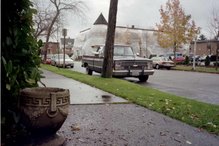
There were one or two snapshots on the roll of film. Earlier on the roll of film was the University of Washington Tacoma Branch during the event to turn parking spaces into park-like activity areas.

The guided tour of all the parking spaces at the Spaces event ended at King's Books.

My day yesterday also ended at King's Books for the Distinguished Writer reading - during the Open Mike I read a translation I had done of a folk song from Swedish-speaking Finland. This weekend Scandinavian Heritage Festival at the fairgrounds, but I am not going there this year.

Wednesday, October 6, 2010

New Issue of Salt River Review Contains Poems and Prose by Laura Jensen

Salt River Review is at a final issue at this point. It celebrates many years of publication by James Cervantes and Greg Simon.

Monday, October 4, 2010

Thoughts About Sunday's Column by Leonard Pitts

"I'd have to be crazy to think of walking 60 miles."

It is National Mental Health Awareness Week. Leonard Pitts' column on Sunday, October 3rd, is about participation in a Walk for the Cure for Breast Cancer. The columnist will be in this walk in the Washington D.C. area from Friday until next Monday. His use of the word crazy is partly colloquial, and

expressions like this in daily life and daily reading cast stigma on people who suffer or who have suffered over psychiatric problems.

His use of the word crazy is partly in reference to his state of mind. By crazy he may mean that he searches his thoughts and wonders if he is using Magical Thinking - Believing that one is able to transcend the laws of cause and effect in order to influence a specific outcome by one;s thoughts, words, or actions. By crazy he may mean that he feels he is in a stage of relapse - Over-extension - in which one feels overwhelmed by daily stress and has difficulty concentrating or attending to the external world -

An event can create challenging stress that becomes an element of mental illness. I wonder if there are columns by Leonard Pitts about psychiatry and psychology. I am reminded of a song by Billy Joel - "You may be right, I may be crazy."

Wednesday, September 29, 2010

Book About Swedish-Finnish Folk Music

A book about Swedish-Finnish folk music by Niklas Niqvist came to my attention when I looked up a folk music song title on the internet. The focus of the book is on the collectors who brought together the folk songs for publication and preservation in the early twentieth century. This book was published in 2008. Close to the end of the book is a summary in English. Songs from this books were a part of the performances of the Runeberg Choir.

Tuesday, September 14, 2010

Books at 12:10 Discusses Then We Came to the End by Joshua Ferris

At Books at 12:10 four people discussed Then We Came to the End by Joshua Ferris. We used some discussion to place the story in 2001. I had sought reference in Dictionary of the Future, by Faith Popcorn, from 2001. We discussed her term, presenteeism: the novel's characters were influenced, by many firings in the company, not to stress-induced illness and absenteeism, but to a sometimes inappropriate presence at the work place. The book is told mostly in first person plural, with episodes of third person. An opinion about this point was that one character's extreme experience separated her, referred to as she, from the others in the story, the others referred to as we. A question came forward about whether we had favorites among the characters. One liked Carl Garbedian, married to Marilyn, who was an oncologist. Two episodes which portray Marilyn dropping Carl outside the building are retold at different points in the story. I liked children who appeared briefly in the story: when Benny Shassburger inherits a totem pole and visits the totem pole's neighborhood, a child is jumping on a trampoline in the next yard. Benny imagines more neighborhood children walking past the totem pole admiringly. In a bio about Joshua Ferris we learn his childhood home until the age of ten was the Chicago area, and in ways I think his Chicago is a reference to those years. The leader, who works at the library, admitted that she chose to have no favorites among the characters, but thought of them, like people she works with, as all contributing what they brought. We shared a story of a gradual entry into the novel, with an earned appreciation of the story as we continued with it. I felt the title invited a study attitude, a look at the ending first and a skim. We discussed the ending, in which only two are left, you and me, which is mysterious.

Wednesday, September 1, 2010

Added Link to Photos

Am adding a link to photos of Tacoma in the 1970's, one that also includes photos of the Alaska State Fair in the 1970's. Cysewski, the photographer, has posted a very large number of photos on line. These were linked to another web site which is not available now.