Last week I wrote a poem, this is the poem:
The Mirror and the Weather
How wind blows across the trees,
rows of song,
all over the floor in pieces.
A figure up at night
in a tent who knows what,
who knows.
Waves, waves, how it happens,
hair, hair, then hair
hear over hair now all howl.
Moths. It falls. It drifts and sleeps now.
This poem was not directly associated with a visit to Tacoma Art Museum where one display was landscape photography by Mary Randlett. I walked through and returned to a group on one wall and I thought - These I am rather especially fond of.
And then I read the copy - one photo appeared on the cover of a poetry book by Denise Levertov, and I am especially familiar with that photo, have looked at is peripherally many times.
Monday, November 19, 2007

Friday, November 16, 2007
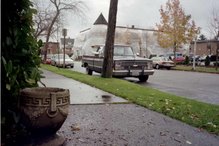
Cement Pot Very Like Pots Made By My Mother's Uncle

Here we see a cement cast pot very like pots made by my mother's uncle. He was from Sweden and returned there to retire. For years there were pots made by my mother's uncle, like these, on the house front steps where we lived.
Tuesday, November 13, 2007
A Poem by Gerald Stern
A poem by Gerald Stern in a recent New Yorker tells of a music box that plays a piece of classical music. At the end of the poem the setting changes - the music box is in a small boat, its bottom filled with an inch of water. Gerald Stern has used the setting to transpose the poem, the poem changes key. It is a comment on the experience of art in uncertain times. The poem came to mind for me in church as the bell choir played.
Robert Hass and a Poem by Tomas Transtromer
Now And Then: The Poet's Choice Columns 1997-2000 (Shoemaker and Hoard, 2007) by Robert Hass, includes a discussion of a poem by Tomas Transtromer for November 29, 1998 (page 111). Robert Hass had been to Shanghai, where "The main experience of Shanghai...like the main experience of New York, is the sheer mass of people on the teeming streets..." The poem by Tomas Transtromer, "Streets in Shanghai", immediately came to mind for Haas:
Behind each one walking here moves a cross that wants to catch up to us, pass us, join us...
The cross in this line is the subject of Robert Hass last paragraph - "One wants to know what that cross is in Swedish and what its resonances are..." The word wants used both by Transtromer and Hass expresses layers of want. One layer is that ambiguity is a kind of aesthetic happiness. To want to know is a joy in itself. This is one part of Hass meditative column about Tomas Transtromer. Another layer is the desire to see the poem printed in original Swedish side by side with the translation - a desire supported by small press.
With the internet we assume answers can happen on the text. This changes the experience of ambiguity for writers.
Friday, November 9, 2007
Historic Papers About Japanese Internment Found
In today's News Tribune there is an article about historic papers about the Japanese Internment. My experience with the historic items is that they exist in the present, and in their tactile testimony we find a difference to our era of Global Warming concerns and our direct experiences with overcrowded highways and ecological concerns in general. We are reminded of the novel by David Guterson, Snow Falling on Cedars, the setting had a dominant part in the novel, as the title shows.
Thursday, November 1, 2007
November Household Suggestion
When you need to clean dirt off vintage pilgrim candles, you can rub them gently with an old nylon stocking.
Subscribe to:
Posts (Atom)